Introduction
As of 2026, the primary factor shaping affordability in Cyprus is no longer the cost of groceries, electricity, or transportation—it is housing. Recent data compiled by Phileleftheros (source) reveals that rental prices have risen across every district, highlighting the growing pressure that housing costs are placing on household budgets throughout the island.
Cyprus has long enjoyed a reputation as one of the most attractive destinations in Europe for both locals and international residents having a lot to offer to both locals and foreigners choosing to relocate to this beautiful and peaceful island. Its Mediterranean climate, relatively low crime rates (that established Cyprus among the safest places to live), English-speaking culture, and high quality of life along with a low tax rate scheme continue to attract, retirees, entrepreneurs, remote workers, and property investors from around the world, establishing the island as an international business and tech-hub center.
Yet one question consistently arises among anyone considering a move to the island and although these findings can be debatable, recent data suggests that life is becoming increasingly expensive and inflation is at its peak.
How much does it actually cost to live in Cyprus today?
The answer is more complex than many people would expect.
For years, Cyprus was considered one of the European Union’s most affordable countries. While that remains true in some respects (such as gas prices), the reality has changed significantly over the last decade. Rising housing demand, limited rental supply in key urban areas, international relocation activity of high-income personnel, and growing economic development have all contributed to higher living costs, particularly in the housing sector.
To break it down in simple words, a lot of businesses that chose to move to their bases to the island, have chosen to bring in personnel from abroad to cover the needs for specialized job roles. These people are highly skilled and their annual earnings usually far exceed the typical earnings of locals. The locals who own properties took advantage of the fact that flat availability is low especially in areas surrounding the city of Limassol and Larnaca which are typically targeted by multinational companies and international investors. This had a domino effect in shaping the country’s real estate property market and although house owners and investors have benefited from these changes, many locals and especially young couples find it extremely difficult to cope with the rising cost of living.
Understanding the true cost of living therefore requires a realistic assessment of rental prices alongside everyday household expenses.
This guide examines the latest rental market data across Cyprus and explores how housing costs influence the budgets of singles, couples, families, and expatriates in 2026.
Housing Has Become the Defining Cost of the Monthly Budget
Historically, rent represented one expense among many in a household budget. In today’s market, it has become the single largest monthly cost for most residents.
Several factors continue to place upward pressure on rental prices:
- Limited Supply of Houses and Flats (especially on the lower end)
- Strong demand from local residents (Inability for home ownership)
- Relocation of international professionals (highly skilled and highly paid)
- Growth of the technology, finance, shipping, and iGaming sectors
- Inflation and Globalization (Wars, shipping costs, oil price)
- Rising construction costs
- Delays in bringing new housing developments to market
- Bank Interest Rates Continue to be high.
As a result, although small island, Cyprus no longer has a single rental market. Instead, housing affordability varies dramatically depending on where someone chooses to live.
A professional working in Limassol faces a very different housing market from a family living in Paphos, or a retiree settling in the Famagusta district.
Latest Rental Market Data for Cyprus (2026)
Average Rental Prices by District (2026)
To provide a clearer overview of the market, the district-level averages below are calculated from the latest rental data across the areas listed in each district.
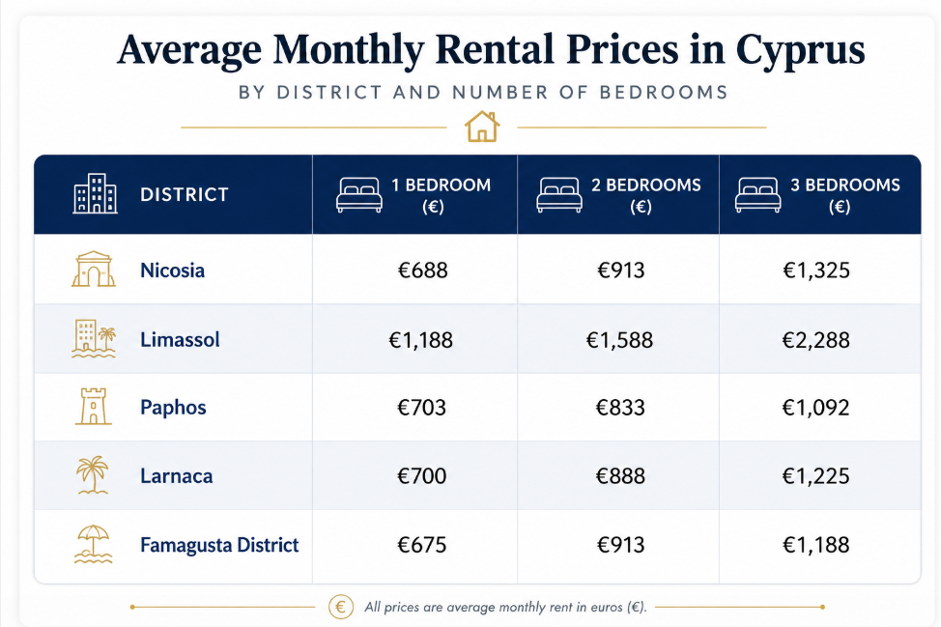
The following figures represent the latest available rental market data and provide a realistic snapshot of average monthly asking rents across major residential areas in each City:
Limassol Remains Cyprus’ Most Expensive Rental Market
Limassol tops the charts when you are looking to understand the changes in the housing market. During the last 10 years, Limassol has become the main international business district of Cyprus, attracting working professionals from all over the world and thus creating interest in high quality rental properties which caused rental prices to increase.
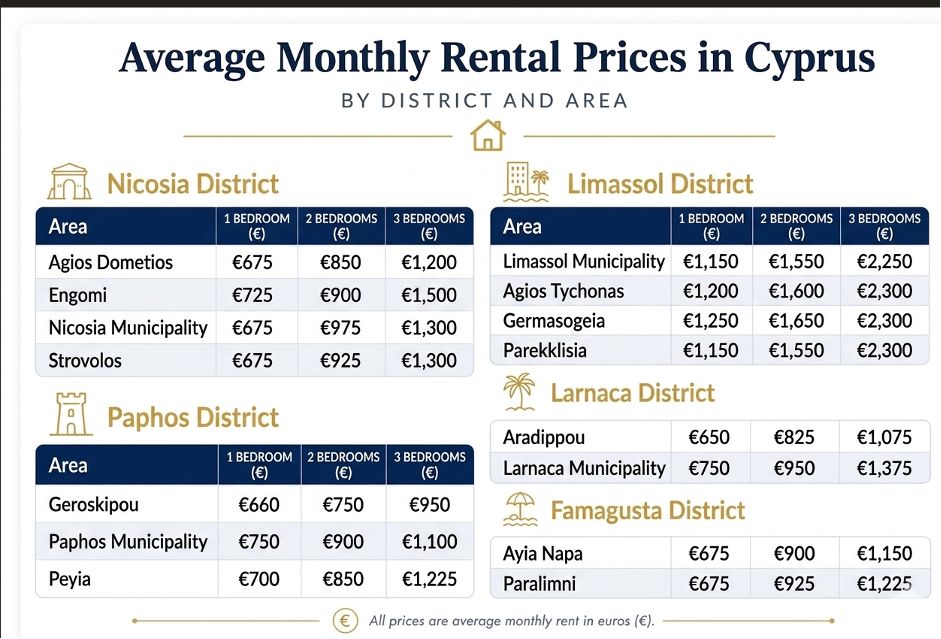
One-bedroom apartments can cost as much as €1,150, and larger family-sized apartments cost over €2,000. For people earning a salary on the international market, these prices are pretty reasonable. Many locals, however, are finding it impossible to cope with these prices.
It is good to mention that by no means can you claim that Cyprus has a highly developed public transportation system, and a personal car is a must have for almost everyone which increases the monthly expenses of a household.
The result is a growing trend toward shared accommodation, longer commuting distances, and increased demand for surrounding areas such as Parekklisia and other suburban communities.
Nicosia Offers a More Balanced Market
Nicosia has a large selection of places available for rent being the capital.
Strovolos, Agios Dometios, and Engomi are usually located in close proximity to work, which is a key reason why government employees, university staff, and other professionals, along with families, prefer to rent near these areas.
Nicosia rents are increasing, but they are still generally cheaper than Limassol rents. Nicosia also has a larger variety of housing, which helps to maintain prices.
Locals prefer living in Nicosia, because it has a lot of job opportunities and it is more affordable compared to other big cities, especially Limassol.
Paphos Continues to Attract Retirees and Remote Workers
Paphos remains one of Cyprus’ most attractive districts for retirees, digital nomads, and lifestyle-focused buyers.
Compared with Limassol and parts of Nicosia, housing costs remain significantly lower.
A one-bedroom apartment in Geroskipou averages approximately €660 per month, while many areas still offer larger properties at prices below those found in the island’s major business centres.
The district’s popularity is driven by:
- Coastal living
- International community presence
- Lower population density
- Good healthcare access
- Strong tourism infrastructure
For individuals seeking a lower-cost Mediterranean lifestyle, Paphos continues to represent one of the most appealing options available.
Larnaca’s Growing Appeal
Larnaca has experienced considerable growth in recent years.
Historically viewed as a quieter alternative to Limassol and Nicosia, the city has benefited from infrastructure upgrades, marina development projects, and increasing international interest.
Rental prices remain relatively moderate compared with Limassol, making the district attractive to both local families and expatriates.
Many residents consider Larnaca a practical compromise between affordability, accessibility, and quality of life.
The city’s international airport also adds a level of convenience that appeals to frequent travellers and remote workers.
Famagusta District Provides Value for Money
The Famagusta district, including Ayia Napa and Paralimni, offers some of the most competitive housing costs among Cyprus’ coastal regions. Rightfully considered to have the most beautiful and clean beaches, it is a small paradise for those looking for a relaxed lifestyle, combined with a beautiful scenery and investment opportunity, this is hands down the clear choice.
While tourist activity can create seasonal fluctuations in certain locations (especially during Summer months), long-term residents often benefit from lower housing costs compared with the major urban centres.
The district is increasingly attracting:
- Retirees
- Young families
- Remote workers
- Individuals seeking coastal living at lower prices
- Investors who look to invest in sea-side villas that are especially rewarding for short-term rentals.
For those prioritising affordability without sacrificing access to beaches and outdoor amenities, the region remains highly attractive.
Beyond Rent: The Other Costs of Daily Life
Although housing dominates most household budgets, it is far from the only expense residents face.
A realistic monthly budget should also include:
Utilities
Electricity remains one of the most significant utility expenses in Cyprus, particularly during summer months when air conditioning usage increases substantially and it is by no means negotiable due to the specific characteristics of the Mediterranean climate combining very high temperature with high moisture making it very difficult to live without the everyday use of an air-condition.
Typical monthly utility costs may include:
- Electricity: €100–€250+
- Water: €20–€50
- Waste collection and municipal fees
- Internet services: €30–€50
- Mobile phone services: €15–€40
Actual expenses vary considerably depending on property size and household habits.
Groceries
Supermarket prices have increased across Europe in recent years, and Cyprus has not been immune to these trends.
A single individual can generally expect to spend between €250 and €450 per month on groceries, while families often spend considerably more depending on lifestyle and dietary preferences.
Imported products typically carry a premium due to shipping and distribution costs but are substantially cheaper compared to local products because of lower labor costs.
Transportation
Cyprus remains heavily dependent on private vehicles.
Unlike many major European cities, public transportation options remain relatively limited for daily commuting and people choose or are essentially forced to own a car.
Household expenses typically include:
- Vehicle purchase or financing
- Fuel
- Insurance
- Road tax
- Maintenance
- Repairs
Car ownership is often a practical necessity rather than a luxury.
Lifestyle Spending Often Gets Overlooked
One of the most common budgeting mistakes is underestimating discretionary spending.
Modern lifestyles increasingly include recurring expenses such as:
- Coffee shops
- Food delivery services
- Streaming subscriptions
- Gym memberships
- Dining out
- Entertainment
- Weekend travel
Individually these costs may seem insignificant. Collectively, however, they can add several hundred euros to monthly expenditure. Many households discover that lifestyle spending has a greater impact on their finances than expected and the social norms seem to enforce this lifestyle habits to the society.
Salary Reality check and Affordability
Perhaps the most important question is not how much things cost but rather whether incomes are keeping pace with the rising cost of living.
Average salary figures often fail to reflect the reality experienced by many workers. While certain industries offer highly competitive compensation packages, many employees continue to earn low salaries. In fact, the almost half of non-Cypriot workers earn less than €1,500. With the average salary being a bit of €2,600, it gets to show the level of wage inequality among the people living in Cyprus experience.
When rent consumes 40%, 50%, or even 60% of household income, financial flexibility becomes increasingly limited.
This explains why:
- More young adults remain with family for longer
- Shared accommodation has become increasingly common
- Demand for suburban housing continues to grow
- Homeownership remains difficult for many first-time buyers
Housing affordability has become one of the defining economic issues facing Cyprus today.
Estimated Monthly Cost of Living in Cyprus
Although individual circumstances vary, realistic monthly budgets in 2026 generally fall within the following ranges:
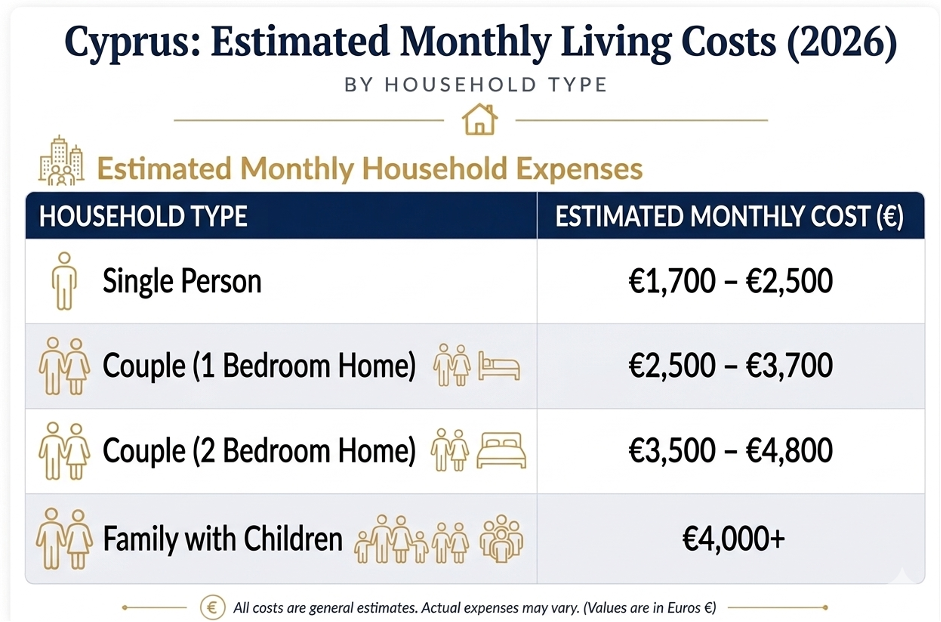
At first glance, some of these figures may appear relatively high. However, they are based on current market conditions and reflect the cost of renting at prevailing market rates, alongside other common household expenses. Actual spending can vary significantly depending on individual circumstances.
Many residents are able to maintain a lower cost of living if they benefit from below-market rental arrangements (especially if they rented the property a few years ago and the increases have not caught up with the current market value), own their home, or receive financial support from family members. This remains a notable characteristic of Cypriot society, where intergenerational support plays an important role in household finances. Parents often assist their adult children with housing costs, property purchases, childcare, and even day-to-day living expenses.
As a result, while the estimates presented provide a realistic picture of the costs faced by households operating independently, the lived experience of many residents may differ due to the strong family support networks that continue to shape economic life in Cyprus.
This should be taken into consideration especially by foreigners looking to reallocate and start a new life in Cyprus.
Final Thoughts
Cyprus continues to offer an exceptional quality of life, combining Mediterranean living with modern infrastructure, strong healthcare, and a growing international business environment.
However, the island’s affordability story has changed. While everyday expenses remain reasonable by many European standards, housing costs have become the defining factor in household finances.
For anyone considering a move to Cyprus in 2026, understanding local rental markets is just as important as understanding salaries, taxes, or employment opportunities. The difference between districts can amount to thousands of euros each year—and increasingly, where you live determines how affordable life on the island will be.
In today’s Cyprus, housing is no longer just part of the cost of living. It is the cost that shapes all the others.
The real question is whether household income can keep pace with the rapidly evolving housing market that increasingly shapes everyday life on the island.